
Product
Orquest maximizes business efficiency through optimal employee scheduling and automation.
 Smart Planning

Size and plan your in-store teams to provide the best customer service and maximize your performance.
 Staffing
 Time & Attendance
 KPIs Tracking
How Arcos Dorados Transformed Scheduling Across 2,000 Restaurants

Mar 30 2026
The world’s largest McDonald’s franchisee needed to align staffing with demand at scale. Here’s what happened.

Arcos Dorados operates over 2,000 McDonald’s restaurants across 20 countries in Latin America. Nearly 60,000 employees. Multiple labor laws. Wildly different demand patterns from Buenos Aires to San Juan.
At that scale, getting scheduling right isn’t an HR problem. It’s an operational and financial one.
The challenge: two demands, one challenging balance
In any McDonald’s restaurant, the kitchen is the engine. Production speed determines service speed. Service speed determines customer satisfaction. And customer satisfaction, ultimately, determines the business.
The problem is that aligning people to production demand is genuinely hard. Especially when you’re doing it manually, restaurant by restaurant, week by week.
Arcos Dorados was running that process across thousands of locations. Managers were spending 6 to 8 hours building weekly schedules, working from gut feel and past experience. Even then, the output was imprecise: overstaffed during slow periods, understaffed when it mattered.
The core tension, as Darío Luksemberg, HR Corporate Director put it, was this:
“How do you guarantee you have enough trained, quality people at the right moment, and at the same time balance labor costs to keep the business financially healthy?”
Those two demands pull in opposite directions. More coverage means higher cost. Tighter cost means gaps in coverage. Traditional scheduling forced managers to pick a side. Neither choice was right.
What Orquest brought
Orquest was deployed across Arcos Dorados’s full network: “a single, standardized platform giving the organization semi-centralized control over scheduling across all locations”, explains Vincent Lamazou, Managing Director at McDonald’s Puerto Rico.
The shift was immediate.
Forecasting changed the game. Instead of working backward from last week, managers could now see weeks ahead: demand predicted per restaurant, per hour, based on historical sales, product mix, and local patterns. The forecast, as Mailliw Pizarro, Operations Consutant described it, is “impressive”, granular enough to treat each restaurant individually, scalable enough to run across 2,000 locations at once.
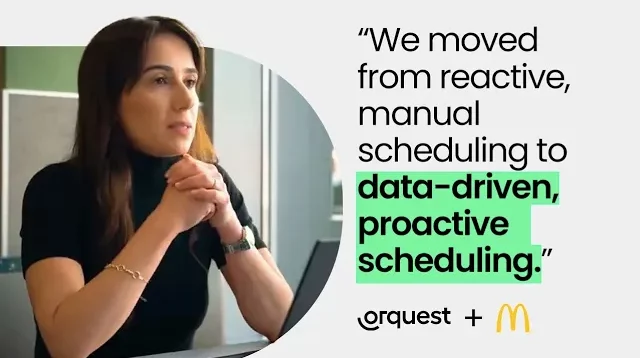
Schedules that used to take 6–8 hours now take 40–45 minutes. Compliant with local labor law. Optimized for coverage. Ready to deploy.
Employees adopted the app quickly. For many, it was their first time having visibility into their own schedules: shift requests, updates, real-time changes. Absenteeism coverage improved. Communication between crew and managers improved. The relationship became less transactional.
And the manager’s role changed. With administrative burden gone, conversations shifted. Instead of firefighting schedules, managers and operations leaders could have strategic discussions: where are we underperforming, where can we optimize, what does the data say?
The results
The numbers Arcos Dorados shared are concrete:
- Labor cost reduced by 0.5–1% across the network, huge when you’re operating at this volume.
- Scheduling time down 90%, from 6–8 hours to under 45 minutes per manager, per week.
- ~$300,000 in annual savings from scheduling efficiency alone.
- Improved employee satisfaction, as staff work more comfortably when the right number of people are covering each shift
- Better customer experience. Faster service when staffing matches real demand
These results hold across 20 countries, each with its own labor legislation. That compliance complexity is handled inside the platform, managers don’t carry it.
Why it works
The underlying principle is simple, even if the execution isn’t: when you can predict what a restaurant will need, you can staff for it. When you staff for it, everything downstream improves: speed, cost, employee experience, customer satisfaction.
“Orquest works with each restaurant individually. That helps us have strategic conversations with business managers and make proactive decisions.” – Sorelys Rivera, Restaurant Manager
What makes this different from a generic scheduling tool is the combination of predictive intelligence and operational specificity. Orquest was built in collaboration with McDonald’s from the start. It understands what a QSR kitchen actually requires: task-level staffing, peak meal windows, skill and certification requirements. The AI models learn continuously from real patterns. The output isn’t a generic schedule. It’s one built around how that specific restaurant actually operates.
What’s next
Arcos Dorados’s HR leadership put it plainly:
“The business changes. Customers change. Employees change. In this evolution, we understand the future goes this way.”
Orquest is already deployed across McDonald’s in more than 40 countries, and across retail and QSR operations in more than 90. The solution continues to evolve: new app capabilities for manager, a redesigned scheduling interface, and new features are all in progress.
The Arcos Dorados story isn’t a one-off. It’s a template for what becomes possible when scheduling stops being a manual process and starts being an intelligent one.
Orquest is an AI-powered workforce scheduling and management solution for retail and QSR. To learn how it works for your operation, book a demo.