
Product
Orquest maximizes business efficiency through optimal employee scheduling and automation.
 Smart Planning

Size and plan your in-store teams to provide the best customer service and maximize your performance.
 Staffing
 Time & Attendance
 KPIs Tracking
AI Gets Real: Global Retail Trends from NRF 2026

Jan 23 2026
NRF 2026 highlights
- AI has moved from experimentation to execution, with retailers focusing on real, measurable impact at both the store and operations levels.
- Workforce optimization has emerged as a key competitive advantage, as brands prioritize better staffing and empowered store teams.
- Orquest delivers AI-driven workforce scheduling at scale, helping global retailers forecast demand, calculate staffing needs, and optimize schedules.
Once again this year, we started January where global retail conversations begin: NRF 2026 at the Javits Center in New York. Like every edition, the show was packed. Big names, bold demos, and ambitious roadmaps. But this year felt different. Less speculation. Less “someday.” More proof.
The theme, The Next Now, summed it up well. Retailers are no longer asking whether AI works. They are deciding where to deploy it to get results now. At NRF 2026, the message was clear: experimentation is over. Execution has begun.
AI moves from the front office to the store floor

AI has dominated NRF stages for years, often through the lens of personalization, search, and checkout. This year, those conversations matured. Google CEO Sundar Pichai made it explicit in his keynote: AI will reshape retail as deeply as ecommerce and mobile once did.
But beyond the headlines, what stood out at NRF 2026 was where AI is finally taking hold: operations.
Retailers are dealing with volatile traffic, omnichannel complexity, labor shortages, and regulatory pressure, all at once. These are not future problems. They are daily realities inside physical stores. And they cannot be solved with dashboards alone.
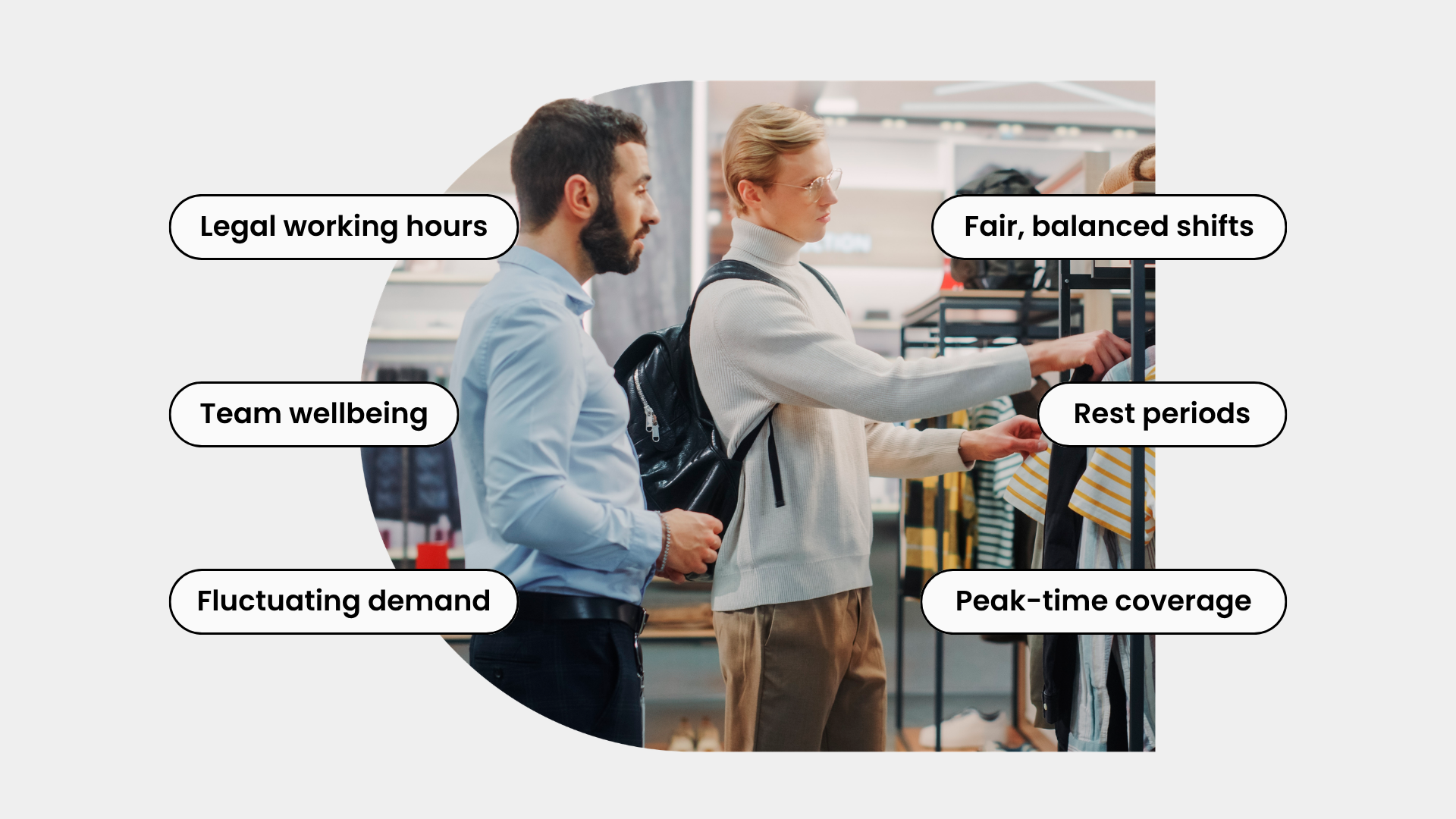
That’s why so many conversations at NRF 2026 came back to execution at the store level. How do you staff correctly when demand changes hour by hour? How do you support associates without burning them out? How do you maintain service quality while controlling labor costs?
Workforce is the real competitive advantage
One thing became obvious walking the floor: winning brands treat their workforce as a strategic lever, not a cost line.
Technology leaders and retailers alike emphasized that the future of retail is not about removing humans from stores. It’s about elevating them. This echoed strongly in sessions with luxury leaders like LVMH, where AI is designed to be “everywhere but visible nowhere.” The goal is augmentation, not replacement.
That philosophy applies just as much to store operations. When staffing decisions are made without accurate demand signals, everyone loses. Customers face long queues or empty aisles. Employees get last-minute changes and unfair shifts. Managers spend hours building schedules that don’t survive the week.
At NRF 2026, many retailers acknowledged that operational friction is now one of their biggest blockers to growth. Fixing it requires AI that works in the real world, across countries, formats, and constraints.
From forecasting to action
What’s changed in 2026 is not just better forecasting. It’s the ability to turn forecasts into action.
Retailers are moving away from static labor models and manual scheduling. They want systems that can anticipate demand at an hourly level, translate it into optimized shifts, and adapt in real time when conditions change. And they want to do it without breaking compliance or employee trust.
This is exactly what Orquest has been doing for years.
Orquest was built specifically for physical retail, where complexity is the rule, not the exception. By combining machine learning forecasting, mathematical optimization, and prescriptive analytics, Orquest helps ensure the right people are in the right place at the right time. Not in theory, but every day, at scale.
Today, Orquest schedules more than 280,000 employees across 90 countries for retailers like H&M, Kiabi, Dior, and foodservice brands such as McDonald’s and Burger King. That scale matters, because it proves that AI-driven workforce optimization can handle different regulations, cultures, and store realities.
Measurable impact, not hype
One of the strongest themes at NRF 2026 was proof. Retailers want measurable impact, not pilots that never scale.
The results shared by Orquest customers reflect exactly what retailers are asking for now. Managers reduce scheduling time by up to 90%, freeing hours to coach teams and support customers. Forecast accuracy exceeds 90%, stabilizing coverage and service levels. Employee turnover drops by 15% thanks to fairer, more predictable schedules.
The commercial impact is just as real. Retailers reported a lift in conversion after deploying Orquest. Queue times dropped by 25%. Labor cost efficiency improved without sacrificing service.
At NRF 2026, this kind of outcome-driven AI stood out. Not flashy demos, but systems that quietly make stores run better.
Crushing the “now” to win the “next”
If there was one mandate coming out of NRF 2026, it’s this: you can’t wait for the future to fix today’s problems.
Retailers that succeed will be the ones who master the “now.” That means turning operations into performance engines. Using AI to remove guesswork. Giving managers better tools. Giving associates better schedules. And delivering consistently better experiences to customers.
The future of retail is not just smarter checkout or faster delivery. It’s smarter operations.
NRF 2026 made that clear. And it’s exactly the conversation we’re excited to keep going.